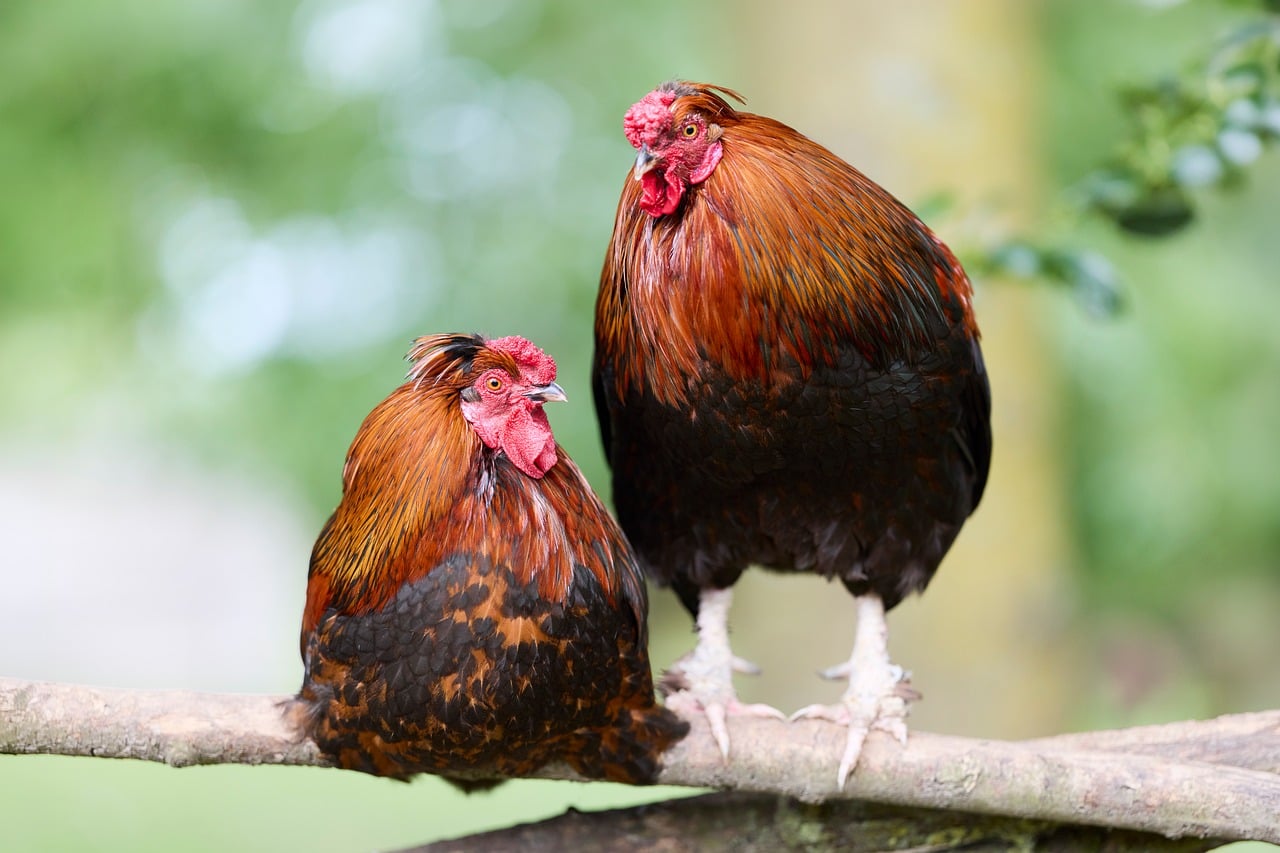
Telling hens and roosters apart is tricky at first, but a handful of tell-tale signs make it much clearer as the birds grow.
It gets easier with age
With very young chicks it is genuinely hard to tell males from females by eye — the differences simply have not appeared yet. From a few months old, though, cockerels (young roosters) start to look and behave distinctly, and by four or five months most keepers can tell them apart with confidence. Patience is the main thing; give the birds time to show their hand.
Signs of a rooster
As a young male matures, watch for these clues:
- A larger, redder comb and wattles that develop earlier than the hens do.
- Long, pointed, glossy hackle (neck) and saddle (lower back) feathers.
- Curved, showy sickle tail feathers.
- Leg spurs beginning to grow.
- Crowing, which usually starts at around 4 to 5 months.
- A bolder, more upright posture, often the first to sound the alarm.
Signs of a hen
Hens are generally the more understated of the two. Look for a smaller comb and wattles, a rounder, lower body, and rounded rather than pointed neck and back feathers. Their tails lack the long curved sickle feathers of a rooster. And of course the surest sign of all is that a hen lays eggs — something no rooster will ever do.
Why day-old sexing is so difficult
You may hear that chicks can be sexed at a day old, and they can — but not by eye in the back garden. Reliable early sexing needs either vent sexing, a skilled and delicate technique, or sex-linked and auto-sexing breeds, where males and females hatch different colours. For an ordinary mixed batch of chicks, waiting a few weeks for the signs above is far more dependable than any guess. If you are raising a batch yourself, see how to raise baby chicks, part of our full chicken-keeping guide.
Behaviour gives it away too
Looks are not the only guide — behaviour often gives a bird away just as clearly:
- Cockerels frequently tidbit, calling the hens over to food with a special repeated cluck.
- They start crowing, and may posture, strut or square up to challenge others.
- Hens have their own egg song, a loud cackle around the time they lay.
- Hens tend to settle into the pecking order more quietly than the bolder males.
The clinchers are simple: a bird that regularly mounts others and never once lays an egg is almost certainly a rooster, while a bird that lays is beyond doubt a hen. If you are raising a batch and waiting for these signs to appear, see how to raise baby chicks.