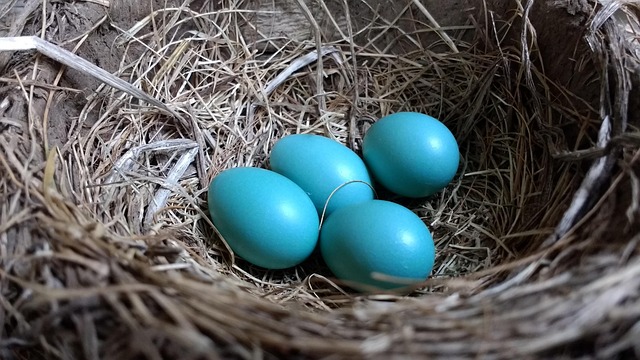
American robin eggs are famous for their bright blue colour and are a classic sign of spring. Here is what to know about their colour, clutch size and nesting.
Why robin eggs are blue
American robin eggs are a well-known sky blue, sometimes called robin egg blue after the bird itself. The colour comes from a pigment called biliverdin, which the female deposits in the shell as the egg forms. Researchers think the blue shade may help protect the developing chick from sunlight while still absorbing some warmth. The eggs are usually unmarked, without the speckles seen on many other songbird eggs. To learn about the adults, see our robin diet guide or the songbirds hub.
Clutch size and incubation
A typical robin clutch holds three to four eggs, though some nests have as many as five. The female usually lays one egg per day until the clutch is complete. She does most of the incubating, keeping the eggs warm for roughly twelve to fourteen days before they hatch. Robins often raise two or even three broods in a single season, building a fresh nest or reusing a sturdy one each time. For more on adult robins, visit the songbirds hub.
The nest
Robins build a sturdy cup-shaped nest from grass, twigs and mud, lined with softer material to cushion the eggs. The female shapes the mud with her body to form a smooth inner bowl. Nests are often placed on tree branches, ledges or human structures such as gutters and porch lights. Once the chicks hatch, both parents work hard to feed them. You can compare robins with other backyard birds through our cardinal diet guide.